Cam Ramsay
To the LighthouseCam Ramsay is the youngest daughter of Mr Ramsay and Mrs Ramsay, a child whose fierce independence repeatedly unsettles the adults’ expectations of obedience and affection. Her movement from a defiant girl on the island to a young passenger on the family’s later voyage to The Lighthouse gives her a distinctive part in the novel’s changing account of childhood, authority, and perception: she resists her father, yet cannot remain untouched by his appeal, and the sea eventually carries her beyond the terms of that conflict.
Identity and Early Character
William Bankes first sees Cam picking flowers on the bank. When a nursemaid urges her to give one to the gentleman, Cam answers with a string of refusals, clenches her fist, and stamps. Bankes, who would have liked a daughter of his own, feels aged and saddened by her resistance. The scene shows how little her behavior conforms to adult wishes: even a small social courtesy becomes a matter she claims the right to refuse.
Her mother’s perspective likewise registers Cam as both a source of trouble and a child to be cherished. Mrs Ramsay thinks of her and James as mischievous, delightful children whom she would like to keep from growing up. Cam’s particular inwardness is apparent when a simple household message fails to command her attention. She has to be called back after racing past her mother, and, when asked to carry news to the cook, seems absorbed in thoughts of her own. Only after Mrs Ramsay waits and prompts her does Cam repeat the message accurately, in a singsong voice. Her attention is not simply defiance: it is also turned toward an interior life whose contents her mother cannot know.
Cam’s vivid imagination is visible in her response to the boar’s skull mounted in the children’s room. Its horns seem to her to branch across the room, and she cannot sleep with it exposed. Mrs Ramsay covers it with her own shawl and invents comforting images of a mountain, a bird’s nest, a garden, and small animals. Cam repeats the images as she grows drowsy. The episode joins her fear to the power of imaginative reassurance, while making her mother’s care an active, intimate response to a child’s particular perception.
Family Life and Childhood
Cam’s relationship with Mrs Ramsay is shaped by practical attention as well as tenderness. Her mother summons her to help with an errand, waits through her distraction, and tries to understand what has captured her attention. When reading to James, Mrs Ramsay knows that Cam is drawn to the word “Flounder”; Cam soon shoots away, leaving her mother and brother to their shared reading. The moment distinguishes the children’s different temperaments without turning Cam’s restlessness into a lack of attachment: she is simply not held by the same activity that comforts James.
Mrs Ramsay’s thoughts place Cam within the broader pressure of family care. The family has eight children, and the house’s disorder, worn furnishings, and constant domestic demands limit the time Mrs Ramsay imagines she might otherwise devote to public needs such as a hospital or a model dairy. Yet her anxiety about the children growing older is most immediate when she thinks of Cam and James. She would like to preserve them as they are, although she knows that childhood cannot be kept still. Cam’s own experience of the household is less serene: later, she remembers her father marching over the children and the atmosphere of his authority as impressions laid down among sounds, scents, and the wash of the sea.
The Voyage and Sibling Alliance
When the family returns after years away, Mr Ramsay, James, and Cam are preparing to go to The Lighthouse. The departure is delayed by their unreadiness and the forgotten sandwiches; Mr Ramsay loses his temper and leaves the room. The expedition begins in an unsettled household, with Cam not yet ready and Nancy asking what should be sent to the Lighthouse. The trip is therefore not a simple fulfillment of childhood expectation: it takes place amid bereavement, absence, and strained family relations.
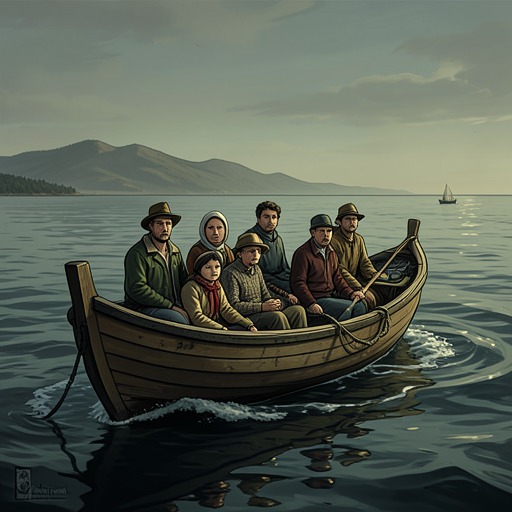
In the boat, James steers while Cam sits alone in the bow, with their father between them. The sails flap, the boat lies motionless, and Mr Ramsay becomes impatient for a breeze, speaking sharply to Macalister’s boy, who begins to row. James and Cam resent being made to come. They have lagged behind their father on the way to the beach, carrying parcels, and silently formed a compact to resist tyranny. Their alliance gives the voyage an oppositional shape: the children share a grievance and sustain one another without openly confronting their father.
That solidarity is tested when Mr Ramsay turns toward Cam and asks about the puppy. Cam feels the force of his appeal to forgive and care for him, while James silently urges her to resist. She reveres justice and sees her brother as its defender, but the emotional positions are not simple: James appears resolute, while their father appears suppliant. Cam answers that Jasper will look after the puppy. Her response gives way on this small point, but it does not erase the conflict; the scene exposes the strain between her commitment to the siblings’ pact and her capacity to respond to her father’s need.
Perception, Change, and Narrative Role
From the boat, Cam sees the island as a small shape on the sea, indented in the middle and marked by two sharp crags. She traces the waves with her fingers and begins to imagine an adventure about escaping from a sinking ship, but does not want to make the story serious. What matters is the sensation of adventure and escape itself. As the boat moves on, her father’s anger about the compass, James’s insistence on their compact, and her own anguish all seem to pass away.
That change is registered as a sudden joy in being alive and present. The sea, streaming through Cam’s fingers, links her immediate physical experience with distant places and histories that begin to stir in her imagination. Her view of the island becomes less a fixed family landmark than a small part of a larger world. The voyage does not settle the antagonism between father and children by argument or declaration; instead, distance and movement alter the emotional conditions in which Cam experiences it.
Cam’s characterization depends on these shifts between refusal, absorption, fear, loyalty, and yielding. Adults sometimes encounter her as a willful child who will not give a flower or answer promptly; the narration also grants her a private imaginative life that exceeds what they can interpret. In the later boat scenes, her independence is neither simply triumphant nor extinguished. She remains bound to James and affected by her father, yet the changing view from the sea makes room for an experience that belongs to her alone: escape not as a final break with the family, but as a momentary release from its quarrels and demands.